Thursday, July 28, 2005
Tuesday, July 26, 2005
Another Green Bottle Fly
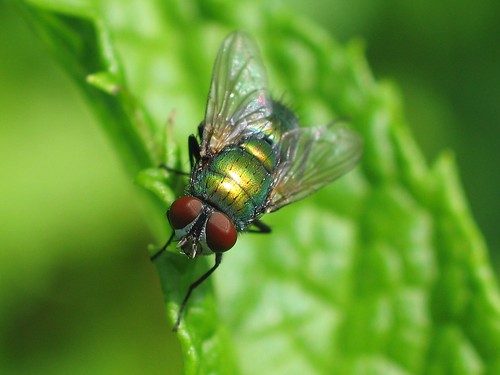
Latin name: Lucilia sp.
Here's another shot of a Green Bottle Fly. Flies close-up are not pretty, especially their faces. The Green Bottle Fly makes up for its fly-ness by being shiny and green and having red eyes. This photo is nicely saturated. The green-ness of the leaf is a nice touch too.

Pole Borer Longhorn Beetle frontal view
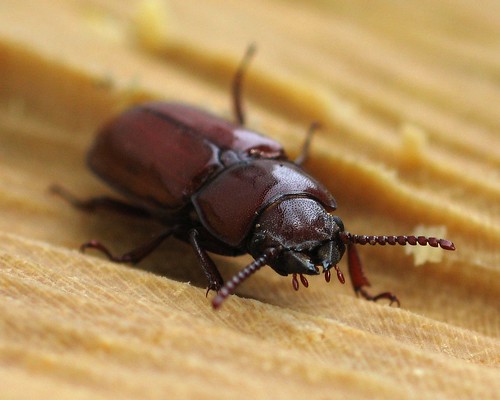
Latin name: family Parandra sp.
Nancy found this Pole Borer Beetle in the back yard two week-ends ago. We put it on a freshly cut stump and I proceeded to take several pictures of it. As with many close-up shots of insects that I take, viewing the photo revealed details not noticed with the naked eye. In this case, I was surprised at the sharp segmentation of the antennae and the wierd little feelers under the head.
Female Wolf Spider with egg sac
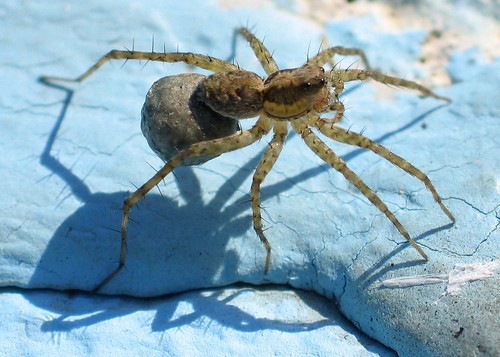
Latin name: family Lycosidae
Here's the same Wolf Spider mother at the edge of the pool. Note how she is not carrying herself so high due to the cooler temperature at poolside.
Female Wolf Spider with egg sac
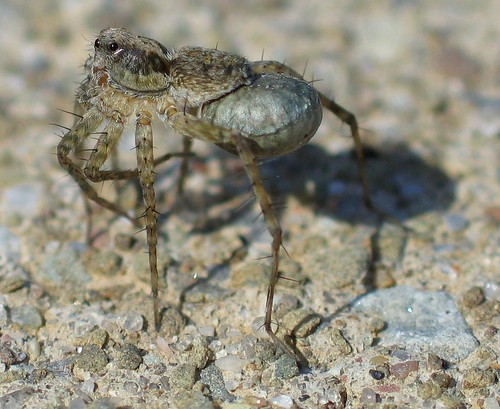
Latin name: family Lycosidae
I was at a public wading pool with the kids this past Saturday. It was rather hot, over 30 degrees. The kids had a great time splashing around. While the kids were lying on their towels soaking up the heat, this little female Wolf Spider with her egg sac tucked beneath her abdomen ran out from the grass onto the cement that surrounds the pool by about 3 metres. It initially ran under Janneke's towel. I shooed the spider away so that it wouldn't bite Janneke if she inadvertently rolled onto it. The spider ran back into the grass and disappeared from sight for a while. About five minutes later she (the spider) reappeared and made a beeline for the pool, in a quick run interspersed with little jumping hops. She went to the edge of the water, took a drink, then proceeded back to the grass. I got a few shots of her as she paused periodically. Note how she raises herself up as far as possible from the hot cement.
Capitalization
I have been at a loss as to the rules of capitalization for named insects. Wikipedia has a good entry on capitalization. Here is a relevant snippet:
Some authors, though few if any grammar books, also treat the names of individual species of living things (animals, plants, etc) as proper nouns, and use initial majuscules for them, as in e.g. Peregrine Falcon while asserting that others, e.g. horse or person are not common names of species and should not be capitalized.
Mating Japanese Beetles
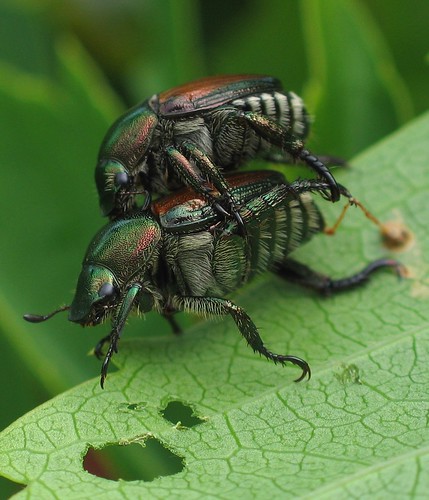
Latin name: Popillia japonica
We visited friends in Welland this past Sunday. They had a rather wild area behind the garage full of Goldenrod, Mint, and grapes that grew over the fence. These Japanese Beetles were found on grape leaves and were obviously in some state of mating. You can see some sort of discharge from the female (the one on the bottom). I am happy with the lighting intensity and clarity of this photo. The field of view is pretty close to lateral, giving good focus along the length of the beetles with a bit of a bias to their heads. This picture has been having a good run on the top20macro group on Flickr (a sort of Darwinian-modelled group whereby everyone is an administrator, only one post per day is allowed, and only 20 posts are allowed in the group).
I had noticed that some Japanese Beetles took on a pose whereby their hindmost limbs would splay out to the side. I think this may be done by females in order to provide purchase to the male when mating (you can see this in the photo). I don't think Japanese Beetles play coy when it comes to reproductive rituals. They pretty well just go at it. Often one can find two beetles mating with a third (presumably a patient male) sitting nearby.
Friday, July 22, 2005
Bottle fly on poppy flower head
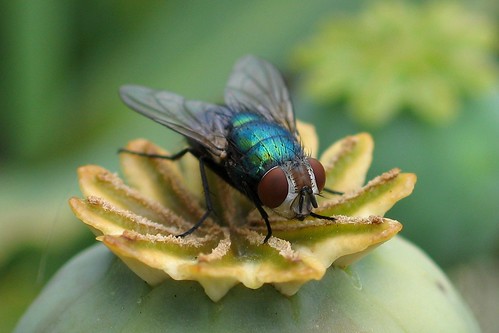
Latin name: Lucilia sp.
This image was quite popular when I posted it on Flickr. Bugs on flowers are passe, but when you post a picture of a bug on a dead flower, well! Seriously, though, the lighting was pretty good for this shot and so was the clarity, without being overbearing. Looking at the phot some more, the depth-of-field worked out pretty well too. The Green Bottle Fly is also pretty, as Blow Flies go.
Picture wing fly
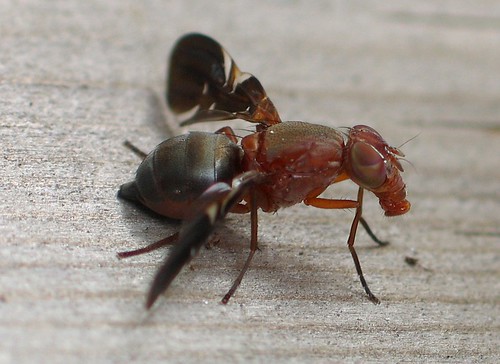
Latin name: Delphinia picta
This is a shot of a Picture Wing fly (got to figure out the rules for capitalization ) that was resting on our rear deck. I was able to stabilize the camera and obtain this clear image. What an odd insect. Most of its oddness comes from its rather elephantine or Tapir-like probiscus.
Male Hover/Syrphid fly on Gypsophila
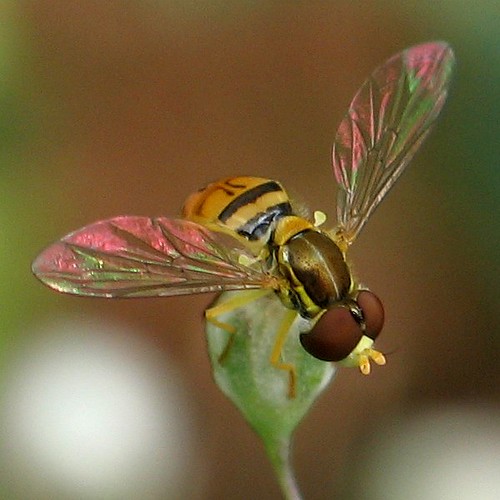
Latin name: Toxomerus sp.
Havn't posted an image for a while. Here's one of a very small (about 6mm) Hover/Syrphid fly that was resting on a Baby's Breath (Gypsophila) flower bud in our front yard garden last weekend.
I like this photo because even with the small size of the fly it provides good detail. Additionally, it is in a pretty well ideal pose, not completely horizontal but stilll giving a full view of the form of the fly. Finally, Hover flies just don't stay still very often. Getting a shot of one is a bit of an accomplishement.
Note the good view of the vestigal rear wings now used for balance only.
Thursday, July 14, 2005
Bruce Scheier interview
Bruce himself pointed to an interview he made. A great quote:
Unfortunately, there are two aspects of modern society that throw this all out of whack. The first is technology. Our security intuition evolved in a world where nothing ever changed. Fear of the new made a lot of sense in that kind of world. But the pace of today's technology means that things change all the time. Look at the Internet: every week there's a new attack tool, a new vulnerability, a new danger. Every year your computer and networks change in some radical way. Technology means that your car, your house, and your bank accounts all have features that they didn't have ten years ago, and people simply don't have the detailed expertise to make sensible security trade-offs about them.
The second problem is the media. Modern mass media has degraded our sense of natural risk, by magnifying the rare and spectacular and downplaying the common and ordinary. If we're wired to make our security trade-offs based on our sensory inputs, media gives us a wildly skewed view of the world. It's why people fear airplane crashes and not car crashes, even though the risk from the latter is considerably higher.
Letter to John Reid, Information Commissioner of Canada
Note: Corrections unfortunately not included in the email sent to John Reid in square brackets.
To: John Reid, Information Commissioner of Canada
From: Ian Marsman
I direct your attention to the website of National Resources Canada, in particular, to the section of the site dealing with downloads of place name data. The data in question deals with populated areas and geological features and includes for each place information including latitude and longitude, province, type of location, etc. In order for a Canadian citizen or anyone else for that matter to gain access to the whole dataset a fee must be paid and a licensing agreement must be agreed to. The fee to be paid ranges from $70 for information about obsolete place names to $660 for the complete dataset. The licensing agreement (called a "sales agreement" on the link to the agreement file) reads like a software end user licensing agreement and includes restrictions on usage, referring to additional licensing that must be obtained if the data is to be accessed from a centralized server. I have a few questions.
I am interested in using data on place names in Canada, the US, and possibly Mexico for a web-based business I am in the process of starting. I will be selling identification cards, posters, games, and other things relating to insects one can find in North America. My target audience is educators and amateur naturalists. In addition to the products I will be charging for I will be providing a service whereby people can submit places where one can find diffferent insects. This information will be available for free. Additional free services may include submission of insect sightings and display of sightings in the context of maps using Googles map service and their freely available map API. The idea is to be able to make a living and also to get people more interested in insects and in issues such as biodiversity and the effects of human enterprise on the natural world. If I am unable to obtain Canadian place name data for free or for the cost of to Natural Resources Canada of downloading I will use the data freely available from the US government. I will then be in the ironic position of providing much better service to Americans than to Canadians, since the US data will be much more comprehensive.
Why is Natural Resources Canada getting in the way of educational and legitimate business usages of Canadian Place name data by Canadians, data whose collection has already been paid for by the Canadian citizen and taxpayer? I could understand a small charge to offset the cost of data storage and transmission bandwidth, but the fees charged and restrictions on usage made don't match this sort of cost-recovery strategy. I'd finally like to note that I wrote [to Natural Resources Canada] a few years ago asking why Natural Resources Canada charges for this data and received a reply that in effect said that this was their policy. This correspondence occurred in the context of my interest in using the data for a course I was teaching at Malaspina University College in Nanaimo, British Columbia. I ended up using the American data. I would appreciate your timely investigation of this matter and reply as to your planned actions. Thank-you very much for your time and attention to this matter.
To: John Reid, Information Commissioner of Canada
From: Ian Marsman
I direct your attention to the website of National Resources Canada, in particular, to the section of the site dealing with downloads of place name data. The data in question deals with populated areas and geological features and includes for each place information including latitude and longitude, province, type of location, etc. In order for a Canadian citizen or anyone else for that matter to gain access to the whole dataset a fee must be paid and a licensing agreement must be agreed to. The fee to be paid ranges from $70 for information about obsolete place names to $660 for the complete dataset. The licensing agreement (called a "sales agreement" on the link to the agreement file) reads like a software end user licensing agreement and includes restrictions on usage, referring to additional licensing that must be obtained if the data is to be accessed from a centralized server. I have a few questions.
- Is it legal to charge a Canadian citizen [for data] whose collection has already been paid for by Canadian taxpayers (I am both a Canadian citizen and taxpayer)?
- Is it legal to place restrictions on the legal usage of the data, restrictions that seem to be designed to extract additional revenue?
I am interested in using data on place names in Canada, the US, and possibly Mexico for a web-based business I am in the process of starting. I will be selling identification cards, posters, games, and other things relating to insects one can find in North America. My target audience is educators and amateur naturalists. In addition to the products I will be charging for I will be providing a service whereby people can submit places where one can find diffferent insects. This information will be available for free. Additional free services may include submission of insect sightings and display of sightings in the context of maps using Googles map service and their freely available map API. The idea is to be able to make a living and also to get people more interested in insects and in issues such as biodiversity and the effects of human enterprise on the natural world. If I am unable to obtain Canadian place name data for free or for the cost of to Natural Resources Canada of downloading I will use the data freely available from the US government. I will then be in the ironic position of providing much better service to Americans than to Canadians, since the US data will be much more comprehensive.
Why is Natural Resources Canada getting in the way of educational and legitimate business usages of Canadian Place name data by Canadians, data whose collection has already been paid for by the Canadian citizen and taxpayer? I could understand a small charge to offset the cost of data storage and transmission bandwidth, but the fees charged and restrictions on usage made don't match this sort of cost-recovery strategy. I'd finally like to note that I wrote [to Natural Resources Canada] a few years ago asking why Natural Resources Canada charges for this data and received a reply that in effect said that this was their policy. This correspondence occurred in the context of my interest in using the data for a course I was teaching at Malaspina University College in Nanaimo, British Columbia. I ended up using the American data. I would appreciate your timely investigation of this matter and reply as to your planned actions. Thank-you very much for your time and attention to this matter.
Tuesday, July 12, 2005
Google Map API
Google has now made available an API to allow embedding of its maps in one's own web pages. The API requires a key, as many web service APIs seem to. Lets you do all of the things unofficial hacks did, namely fetch a map, set zoom level, place markers with accompanying text, etc. One can use the API on websites when the page containing the map does not require any sort of payment to access.
Thursday, July 07, 2005
Free software users/developers as "believers"
Letter to the globe in response to an article published on the failure of passage of legislations allowing patenting of software in the EU.
This is an odd way to describe people on two sides of a debate over software patents. "Big business" presumably refers to a group of people and corporations involved in doing business, in carrying out a group of activities. Now, the term "free software believers", what does that refer to? Does it refer to a group of armchair philosophers, advocates, zealots, what? It might come as a surprise to the author of this article to learn that the Globe and Mail's website runs on the Apache webserver which itself runs on the Linux operating system, both examples of free software. If any of this software was made unavailable through lawsuits under new patent legislation, the effects on the Globe would be very measurable, just as they would be if the availability of the proprietary Sun or Microsoft or Adobe software the Globe uses changed. In summary, the allowing of software patents could have very real and very measurable business implications for not only advocates of free software but also many who had no idea how important free software was in putting bread on their tables.
Any change in law can have ramifications felt differently by different groups. Calling users, developers, and advocates of free software "believers" trivializes the very real stake these people and business interests have in how patent law is implimented and interpreted.
"Wednesday's vote was preceded by weeks of massive lobbying between big businesses and free software believers."
This is an odd way to describe people on two sides of a debate over software patents. "Big business" presumably refers to a group of people and corporations involved in doing business, in carrying out a group of activities. Now, the term "free software believers", what does that refer to? Does it refer to a group of armchair philosophers, advocates, zealots, what? It might come as a surprise to the author of this article to learn that the Globe and Mail's website runs on the Apache webserver which itself runs on the Linux operating system, both examples of free software. If any of this software was made unavailable through lawsuits under new patent legislation, the effects on the Globe would be very measurable, just as they would be if the availability of the proprietary Sun or Microsoft or Adobe software the Globe uses changed. In summary, the allowing of software patents could have very real and very measurable business implications for not only advocates of free software but also many who had no idea how important free software was in putting bread on their tables.
Any change in law can have ramifications felt differently by different groups. Calling users, developers, and advocates of free software "believers" trivializes the very real stake these people and business interests have in how patent law is implimented and interpreted.
Wednesday, June 29, 2005
Water lily in marsh
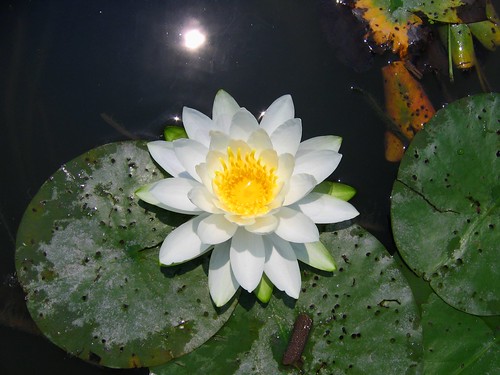
Latin name: Nymphaea odorata
This is the most popular of the Water lily photos I've posted. It is indeed balanced, with an inky black water region, a green lily pad region, an interesting browned lily pad section, and the lovely flower at the centre. The reflection of the sun above the flower is evocative as well. The flower's brightness makes a good contrast with the darkness of the water and the lily pads. From a technical standpoint, I was able to avoid glare and get reasonable sharpness of detail by holding my polarizing filter over the camera lens.
Many pictures of Water lilies I've seen are bright and well saturated throughout. I like the fact that this one has a lot of dark elements, an inky look to the water, and insect-eaten leaves. It gives the feel of the marsh, a different feel from a swimming pond or lake edge. A marsh has the feel of a messy, lively hive of activity and fermenting plant matter. A bright lily in a marsh is the sign of a momentary escape from ferment.
Long-jawed Orb weaver spider
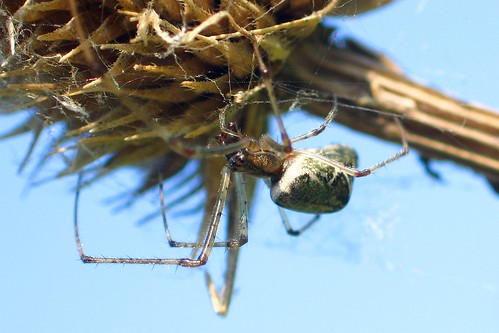
Latin name: Tetragnatha sp.
Here's a female of the same species as the one posted below. A good example of sexual dimorphism. Note the excellent match between her colouration and the dried out thistle she is on. It was really a bit of a fluke that I noticed her at all.
Long-jawed Orb weaver spider
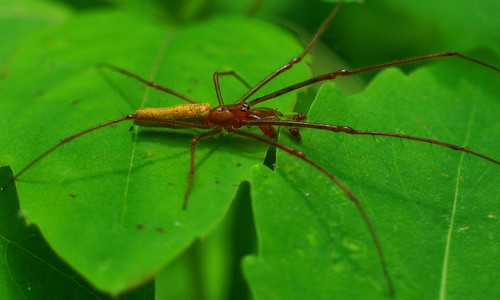
Latin name: Tetragnatha sp.
I'm pretty pleased with this shot of a Long-jawed Orb weaver. It was taken in pretty poor light I think at 1/60 sec exposure time. This is a male of the species. I'm not sure exactly which species it is. There were many of these fellows hanging out on top of the leaves of the Touch-me-nots that covered the forest floor in the hickory forest at Selkirk provincial park where we went camping this past weekend.
Cobweb spider with prey
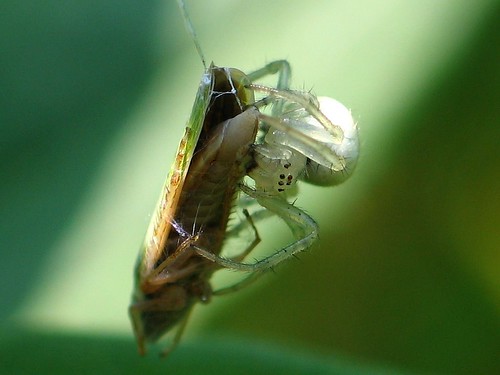
Latin name: Enoplognatha ovata
Here's another Cobweb spider at work. This one's captured a firefly or some other related beetle. I hadn't really known much about Cobweb spiders until this past weekend's camping trip. They are spiders that spin disorganized webs and usually have rather round abdomens. A Black Widow is a Cobweb spider. It's difficult to nail down which species a Cobweb spider belongs to. There are several and they vary a lot within species as well.
Cobweb spider with prey
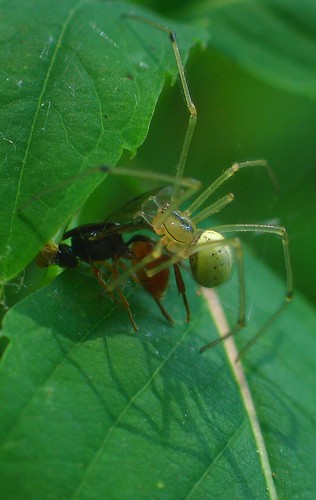
Latin name: Enoplognatha ovata
Not that many people have looked at this picture on Flickr. I like it a lot though. Not surprisingly, in retrospect, pictures that seem to be popular are ones that show up well as thumbnails. I enjoy this shot because it shows a Cobweb spider about to bite into newly captured prey. It's hard to get a picture of an insect doing its thing. Mostly one is happy to capture one after having chased it all over the foliage or over countless rocks.
Monday, June 20, 2005
Mating Wool Carder bees on Lamb's ear
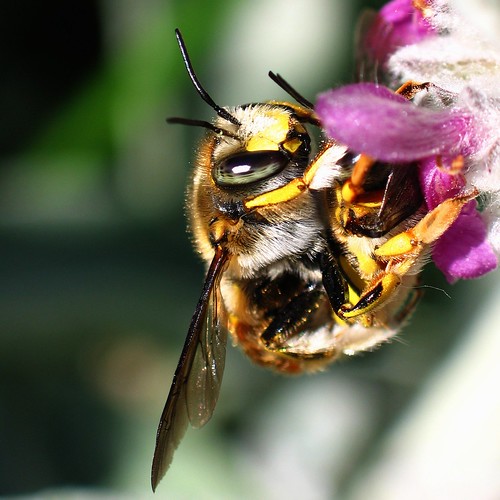
Latin name: Anthidium manicatum
Yesterday at around four in the afternoon I was still hoping to get some more insect pictures. However, I was unable to go to a wonderful park. Fortunately, our neighbours have a patch of Lamb's ear in their front yard. I got some photos of Wool Carder bees, including this one of two of them mating. The male Wool Carder bee will scare competition away from a nice patch of flowers but will let females through, then mate with them once they've fed. Females apparently gather fuzz from plants like Lamb's ear and then work it to make a nest in a manner similar to a person carding wool. From this picture, mating does not seem to be either glamourous of fun for the female, whose wings get bent down by the male (this does probably protect them).
The Wool Carder bee is an introduced species from Europe.
Colorado potato beetle larvae dining on nightshade leaves
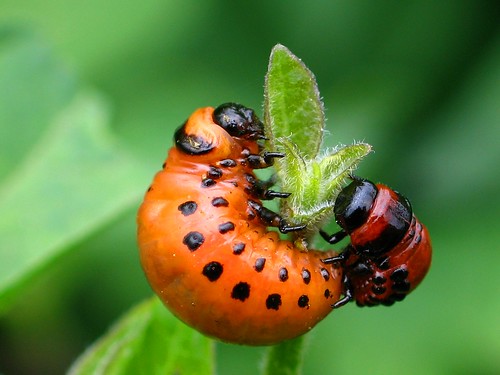
Latin name: Leptinotarsa decemlineata
Nancy and I went to a garden centre this past Saturday. While Nancy was ogling herbs and ground cover, I looked around the place for insects to photograph. In a grassy area by a pool of water in a culvert I found many Colorado potato beetles munching away on Deadly Nightshade leaves.
The Colorado Potato Beetle is actually thought to have originated in Mexico somewhere. It feeds on plants in the Nightshade family, which inludes the potato, tomato, petunia, tobacco, and eggplant. The increase in cultivation of the potato led to its spread around North America. Members of the Nightshade family of plants produce alkaloyds at dangerous levels various parts of the plant. The orange colour of the Colorado Potato beetle larva may serve as a warning that it is toxic.
Female Dolichopodid fly
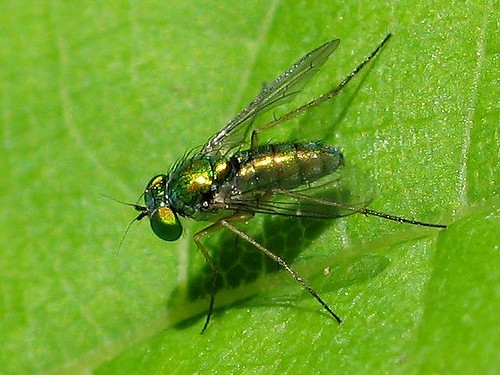
Latin name: Dolichopodid (family)
Here's a female Dolichopodid fly, also known as a Long-legged fly. She was being harassed by a hovering, hopeful male.
Male Dolichopodid fly hovering over female
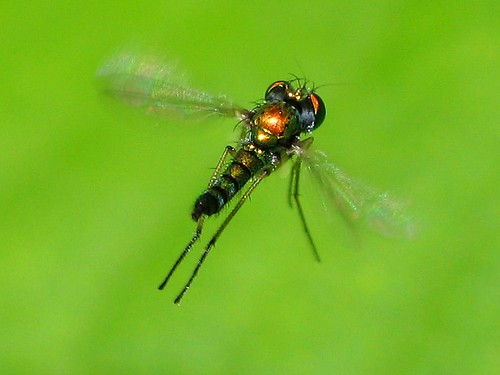
Latin name: Dolichopodid (family)
I was so pleased to get some shots of a Long-legged fly in flight. This is a male Long-legged fly. He was hovering over a female hoping to mate. The light was good so I was able to have the shutter speed at 1/800 second. Faster would have been even nicer.
Surprisingly, this shot has gotten little attention on Flickr, much less than an earlier shot of mating worms. I am apparantly a poor judge of what will be popular.
Wednesday, June 15, 2005
Attempting a meal
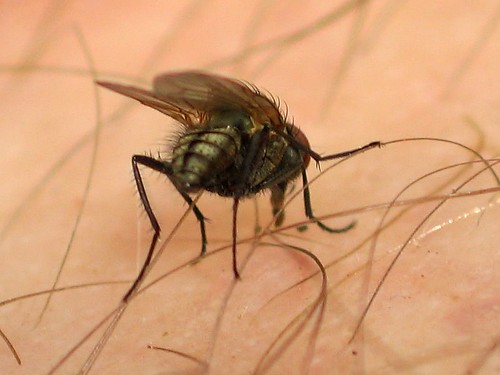
I got this photo of a fly starting to bite into my leg last Sunday afternoon. I got another of a horsefly, but it was fuzzy. Have to try again for a clearer shot (cringe).
Sac spider
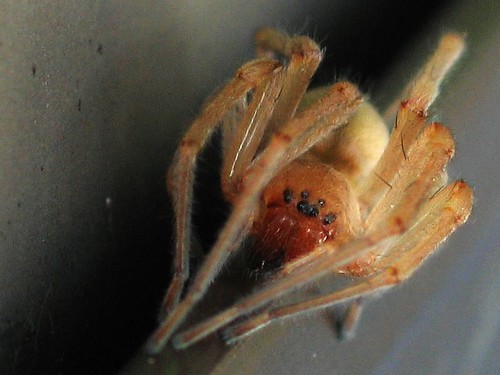
Latin name: Clubiona sp.
Our house has been the home of several Sac spiders. I generally consider myself to be a friend to bugs. For the most part if we find a bug in the house we gently put it outside. Not so for the Sac spider whose bite is cytotoxic (kills cells) and painful. Putting a Sac spider outside would risk having someone get bitten there. Lewis has a small body mass and would suffer rather a lot from a bite. I choose to kill those we find. This one I kept in a jar and photographed yesterday after work. Then I squished it.
Tuesday, June 14, 2005
Bug site
The University of Kentucky has a great site on bug identification and categorization, including sections on plant bugs and assassin/ambush bugs. Very helpful.
Monday, June 13, 2005
Grasshopper
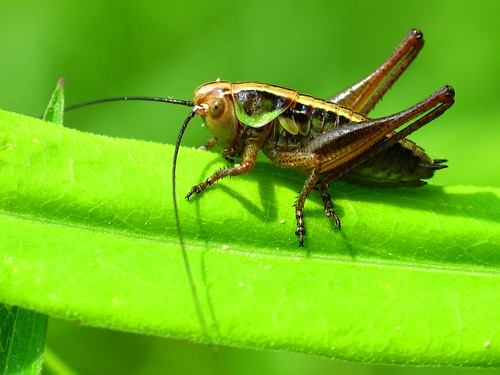
Latin name: Orthoptera (order)
I don't much go in for grasshoppers, but the shot of this one turned out to be quite clear. Pictures of bugs on bright green foliage often get comments on Flickr from people who admire green things or things that are brightly coloured.
Assassin bug
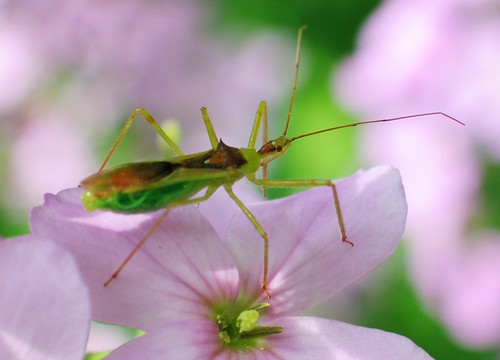
Latin name: Reduviidae (family)
Here's an assassin bug. Its abdomen seems to be filled with what looks like bright green goo. I'm not sure if this is the case as I didn't try to squish it.
Damsel bugs?
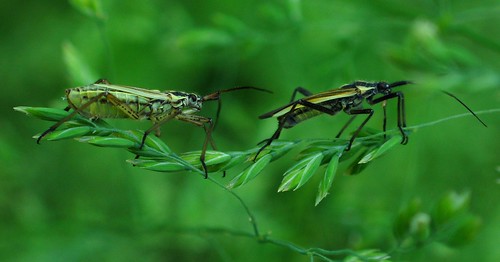
Latin name: Nabidae (family)
I've come across a new category of bugs, namely bugs that stab and poison then suck their prey dry. This category includes Assassin and Ambush bugs (family Reduviidae) and Damsel bugs (family Nabidae). I think that the bugs pictures here might be a nymph (left) and adult Damsel bug. You can see their sucking parts, folded back in the nymph and pointed down in the adult. Perhaps they're male and female adults of the same species or different species. I don't know yet. All of these killing bugs can be found in profusion in grassy fields.
Phidippus clarus spider on clover leaf
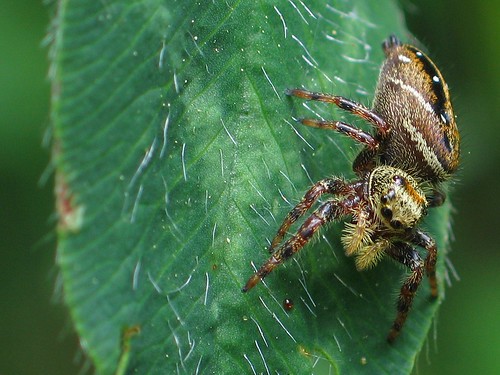
Latin name: Phidippus clarus
I have been hoping to find Phidippus jumping spiders in Ontario and did indeed find one this past Saturday at Short Hills provincial park in the form of this female Phidippus clarus. Rather, Janneke found it and I photographed it. She's good.
Subscribe to:
Posts (Atom)