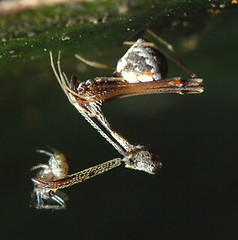
 You have an informative article on newly discovered species of assassin spiders from Madagascar. Unfortunately, the person writing the story chose to depict them as bizarre and ugly, with phrases such as "recognized by their peculiarly ugly, stretched-out necks and sword-like fangs" and "venom-loaded fangs, attached to the ends of grotesquely stretched-out jaws". Perhaps the author has a particular dislike of spiders or perhaps he wanted to avoid sounding too "sciency". Whatever the reason, I think that descriptions of well adapted spiders as ugly and bizarre does both the spiders and the intelligence and curiosity of your readers a disservice. Most of those who read the article will most likely be there because they find spiders interesting, not horrific. Besides, from the first image the spiders' jaws, head, and necks look a lot like the beak, head and neck of a pelican or stork. One doesn't hear of the blue heron as "having a grotesquely long beak adapted for stabbing its unsuspecting prey from above with lightning speed". In parting I'll leave you with a link to some images of beautiful, well adapted spiders
Tuesday, February 14, 2006
Letter to the Discovery Channel
You have an informative article on newly discovered species of assassin spiders from Madagascar. Unfortunately, the person writing the story chose to depict them as bizarre and ugly, with phrases such as "recognized by their peculiarly ugly, stretched-out necks and sword-like fangs" and "venom-loaded fangs, attached to the ends of grotesquely stretched-out jaws". Perhaps the author has a particular dislike of spiders or perhaps he wanted to avoid sounding too "sciency". Whatever the reason, I think that descriptions of well adapted spiders as ugly and bizarre does both the spiders and the intelligence and curiosity of your readers a disservice. Most of those who read the article will most likely be there because they find spiders interesting, not horrific. Besides, from the first image the spiders' jaws, head, and necks look a lot like the beak, head and neck of a pelican or stork. One doesn't hear of the blue heron as "having a grotesquely long beak adapted for stabbing its unsuspecting prey from above with lightning speed". In parting I'll leave you with a link to some images of beautiful, well adapted spiders

Thursday, January 26, 2006
Chandler is coming along
The Chandler project, started by Mitch Kapor of Lotus fame, is finally starting to look polished and usable. At the moment, the most polished component is the calendar, which has some beginning ineroperability with the server using CalDav. Previously, there were no screenshots of the application, mostly, I suspect, because it was so ugly. It takes a long time to get the backend for such a data-driven application going and yet more time to get the backend hooked into the front-end. Congrats!
Wednesday, December 21, 2005
The recent White House wiretap affair and technology
ars technica has a great overview of the probable technology behind the recent non-authorized wiretapping affair. I am not at all a fan of a leader, American, Canadian, or other, feeling that he or she has the authority to eavesdrop on the lives of its citizens with not even minimal oversight. However, that is not what I am most interested in here. The ars technica article outlines an eavesdropping system that essentially samples up to one percent of phone conversations being made at any given time. Knowledge of details such as the country being called is used to home in on the most desirous calls, but the fact remains that an automated system will still come up with a few thousand possible phone lines to monitor every day. The decision as to whether or not a call is of interest is made, at least in part, by looking for keywords in call conversations. So, what we end up with is a surveillance system set up in many ways as a high-tech fishing expedition. The premise for a judicially approved wiretapping system is that wiretaps will be made based on pre-existing evidence. This is at odds with a technology-driven system that uses keyword matching as a large part of its algorithm. No free and fair judicial system would approve wiretapping of its citizens purely on the basis of their having uttered forbidden words while talking on the phone, yet that is what this technology demands. We have a basic conflict here between a technology and its needs and a democracy and its underpinning values and rules. The technology's judgements become our new judgements. Now, instead of being guilty of having done something illegal, we are guilty of having uttered something forbidden. The axis of our system of justice and valuations of freedoms is moving to a new centre of gravity.
The ars technica article points out that for all its technological beauty, the system being pushed is not one likely to notice only criminals. It is very likely that a machine-driven system will end up flagging lots and lots of non-criminals as potential terrorists or drug dealers or whatever. Once flagged by a beaurocracy, especially one that loathes oversight and transparency, one is always suspect. We seem to be swimming farther and farther into dangerous waters with very little thought to the implications of our actions. The love of technology instead of thoughtful human insight is not only an American problem. Perhaps they are the early adopters. Perhaps Canada's spies are even less accountable than ours. Perhaps the US system is more leaky or more transparent. The point is that as long as we undervalue human judgement and insight and the checks and balances that keep us free from tyrrany and overvalue technology, we are at risk.
Update: Josh Marshall comments on this as well
From a technological point of view there's not really much outlandish about this at all. This is just the sort of thing the NSA is in the business of doing overseas. But you can see how this would just be a non-starter for getting a warrant. It is the definition of a fishing expedition.May I submit that wholesale eavesdropping on people around the world is outlandish, especially if it's done with minimal oversight. The bigger the machine the bigger its appetite and the more likely it will turn on its creators.
Friday, October 21, 2005
Testing Flock Blog editor
Well. Here goes. Downloaded the preview release of the Flock browser and am testing it out. Uses de.licio.us to store bookmarks and hooks into blogging. We'll see how revolutionary it is.
Monday, August 22, 2005
Be-pollened Eastern Carpenter Bee

Latin name: Xylocopa virginica
Bees are busy and difficult to photograph. I did however manage to get get this side profile of an Eastern Carpenter Bee covered with a remarkable amount of pollen.
Phidippus clarus female hiding out on Parsley leaf

Latin name: Phidippus clarus
This little female Phidippus clarus was hiding out in our Parsley. The pose shown here is the typical defensive posture; crouching and ready to strike while maintaining maximal ability to view surroundings.
Green Bottle Fly on Sweet Pea flower

Latin name: Phaenicia sericata
This is the unpleasant part of flies (besides their oftentimes diet of rotting flesh or garbage). The front of their heads looks like the front of a human skull, or at least the nose part.
Jumping spider - Sitticus sp.

Latin name: Sitticus sp.
This teeny Jumping Spider was found by Janneke on the sill of our living room picture window. It was only about 2mm in length, total. I brought it outside to our porch and took some pictures of it. It's amazing that something so small can be so complete and capable.
Red-banded Leafhopper

Latin name: Graphocephala coccinea
These bugs are cute and colourful! I don't know how it's adaptive to be red and blue on a green leaf. Perhaps it's less conspicuous in the spectral range visible by its predators. In any case, they look great to humans. Teeny too (about 7mm).
Green Bottle Fly on paving stone

Latin name: Phaenicia sericata
I am not normally a fan of flies, but yet I keep on taking pictures of Green Bottle Flies. It's the irridescence. Looking at them face-on is not pretty, I think because they have indentations similar to those one might see on a human skull. Of course, the fact that they start out as maggots in rotting flesh can be off-putting. In any case, horrid or not, this fly was grooming himself on the lovely walkway through our garden when I took its photo.
Since she's gotten new grandkids my mother simply refuses to use cool shots like this as her computer wallpaper. Imagine!
Thursday, August 11, 2005
Long-jawed Orb Weaver on reeds
Old

New

Latin name: Tetragnatha sp.
I re-edited a shot of a female Long-jawed Orb weaver on some bent reeds to bring out the colour more (I blogged about it before). Now the colour is warmer, reminding me of how things look on moist, overcast days. What a spider!
New
Latin name: Tetragnatha sp.
I re-edited a shot of a female Long-jawed Orb weaver on some bent reeds to bring out the colour more (I blogged about it before). Now the colour is warmer, reminding me of how things look on moist, overcast days. What a spider!
Platycryptus on windshield
Old (non colour adjusted)

New (colour adjusted)

Latin name: Platycryptus sp.
Last night I used the GIMP to do more clean up an image I'd already posted to Flickr. The challenge was to reduce the visual influence of the blueness of the windshield on which the spider stands. The spider, thankfully, did not have any natural blue colouration, so turning down blue and magenta saturation accomplished this goal quite well. This allowed the subject to become much more visible relative to its background. Secondarily, I found that the Gimp allows one to define white and black reference colours in its colour spectrum selector tool. Doing this had the effect of removing a blue cast on the spider's white hair that I hadn't noticed earlier. It seems the camera's electronics where overwhelmed by the blue background and added the cast. In addition to removing the cast, the black/white baseline choosing made the whole picture more clearly defined.
I'm glad I've discovered the black/white baseline setting capabilities of the GIMP. It should help make my images much more attractive. I'm sure Photoshop does this very very well too. However, it costs $500.
New (colour adjusted)
Latin name: Platycryptus sp.
Last night I used the GIMP to do more clean up an image I'd already posted to Flickr. The challenge was to reduce the visual influence of the blueness of the windshield on which the spider stands. The spider, thankfully, did not have any natural blue colouration, so turning down blue and magenta saturation accomplished this goal quite well. This allowed the subject to become much more visible relative to its background. Secondarily, I found that the Gimp allows one to define white and black reference colours in its colour spectrum selector tool. Doing this had the effect of removing a blue cast on the spider's white hair that I hadn't noticed earlier. It seems the camera's electronics where overwhelmed by the blue background and added the cast. In addition to removing the cast, the black/white baseline choosing made the whole picture more clearly defined.
I'm glad I've discovered the black/white baseline setting capabilities of the GIMP. It should help make my images much more attractive. I'm sure Photoshop does this very very well too. However, it costs $500.
Monday, August 08, 2005
Male Black and Yellow Argiope

Latin name: Argiope aurantia
This male Black and Yellow Argiope was literally hanging around above a female in her web, waiting patiently to mate. The female is visible here as the earth is visible to an orbiting satellite. One can see the male transferring some sperm to his palps. I read that males of this species die at the end of mating to inhibit other males from getting at the female. After resting for about twenty minutes the female will pick the male off and eat him, but but that time it's too late for other males.
Wolf Spider lateral view

Latin name: Hogna frondicola
This Wolf Spider was wandering about on the large stone I used as a background for the grasshopper photos I took. As with the grasshopper, I used a polarizing filter on shots of this spider. This spider had a total length of about 9mm.
Two-Striped Grasshopper frontal view

Latin name: Melanoplus bivittatus
Well, I don't get too excited about grasshoppers, but Janneke suggested I photograph one she'd caught and was keeping in her bug collection cage. She said that after release it would stick around for a while. True enough, when we placed it on a large hunk of stone it stuck around long enough to take about a dozen photos. They turned out ver well indeed. I used a polarizing filter to cut down on glare from the rock and reflection from the grasshopper.
Wednesday, August 03, 2005
Fishing spider on stone

Latin name: Dolomedes tenebrosus
This is a good rear view of a female Dark Fishing Spider (Dolomedes tenebrosus). She has a missing leg. This is not as uncommon as I'd have thought before taking so many spider pictures this summer. Perhaps they lose limbs in their nursery web or in territorial combat with others of their species.
Tuesday, August 02, 2005
Black and Yellow Lichen Moth on flowers

Latin name: Lycomorpha pholus
Also known as the Black and Orange Lichen Moth and the Black and Red Lichen Moth. Its colour varies by region. This lovely specimen was feeding on flowers in a garden by a restored grist mill we were visiting last Sunday.
Butterfly on Goldenrod

Latin name: Phyciodes sp.
Got just one shot of this butterfly on Goldenrod, but it was a good one.
Restored late 1800s mill

Near Brock University and the site of the War of 1812 Battle of Beaver Dams is a fully restored grist mill with accompanying mill pond. Beyond the mill is a spectacular waterfall and lovely river gorge. All of this is home to delightful insect life, including huge Millipedes and gargantuan Fishing Spiders. The skill and devotion put into restoring what once was a dilapited wreck of a mill is inspiring.
"The acquisition of Canada this year, as far as the neighborhood of Quebec, will be a mere matter of marching, and will give us experience for the attack of Halifax the next, and the final expulsion of England from the American continent."I'm thankful for more peacable times.
-- Thomas Jefferson in a letter to W. Duane on Aug 8, 1812
Funnel Spider and prey
(1)

(2)

(3)

(4)

Latin name: Agelenopsis sp.
This past Saturday morning I put an ant in a Funnel Spider's web and photographed the ensuing subduing. The results were pretty graphic and kind of sobering. Number 3, shown here, I found especially troubling. One steps on ants, one poisons ants, one watches ants teeming about the garden. One does not always see an ant one has put in a web gaping as he's fatally bitten by a spider.
(2)
(3)
(4)
Latin name: Agelenopsis sp.
This past Saturday morning I put an ant in a Funnel Spider's web and photographed the ensuing subduing. The results were pretty graphic and kind of sobering. Number 3, shown here, I found especially troubling. One steps on ants, one poisons ants, one watches ants teeming about the garden. One does not always see an ant one has put in a web gaping as he's fatally bitten by a spider.
Long-jawed Orb Weaver on reeds
Latin name: Tetragnatha sp.
Long-jawed Orb weavers are neat, but not photogenic. They are too good at camouflaging themselves and don't look enough like regular spiders to stand out in a photo. Thus, when I post one on Flickr I don't expect lots of views, even if it's a photo I think is very good. Bright green grasshoppers are popular though and bright orange Colorado Potato Beetle larvae.
Jagged Ambush bugs on Goldenrod

Latin name: Phymata pennsylvanica
Finally! Got some shots of Ambush Bugs. They were on my list for this summer bigtime. They act a whole lot like Mantids, attacking swiftly from a position of ambush. They have a sucking mouthpart that they stab into their victims and use to suck out their body fluids. Notice the hooked ends on their forelimbs.
Fishing spider frontal view

Latin name: Dolomedes tenebrosus
Nancy found this huge spider on a stone in a creek where we were exploring. The creek flowed through a protected river gorge, providing a great environment for rather large insects to thrive. This is a female Dark Fishing Spider, one of three species of Fishing Spider I've come across in Ontario. It lives in North America east of the Rockies.
Although this individual was large (about 5cm), Nancy soon found an even larger one (about 7cm). I had not expected such large spiders to be found in Ontario outside of a zoo.
Note the missing leg on this spider's left side.
Thursday, July 28, 2005
Tuesday, July 26, 2005
Another Green Bottle Fly
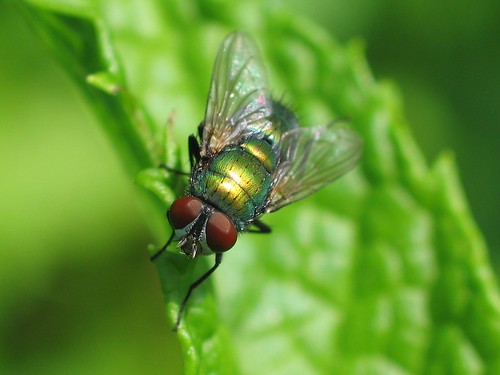
Latin name: Lucilia sp.
Here's another shot of a Green Bottle Fly. Flies close-up are not pretty, especially their faces. The Green Bottle Fly makes up for its fly-ness by being shiny and green and having red eyes. This photo is nicely saturated. The green-ness of the leaf is a nice touch too.
Pole Borer Longhorn Beetle frontal view
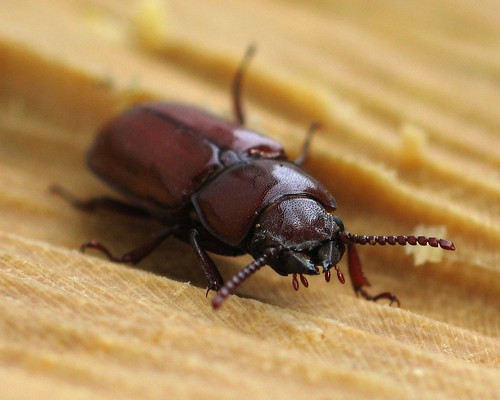
Latin name: family Parandra sp.
Nancy found this Pole Borer Beetle in the back yard two week-ends ago. We put it on a freshly cut stump and I proceeded to take several pictures of it. As with many close-up shots of insects that I take, viewing the photo revealed details not noticed with the naked eye. In this case, I was surprised at the sharp segmentation of the antennae and the wierd little feelers under the head.
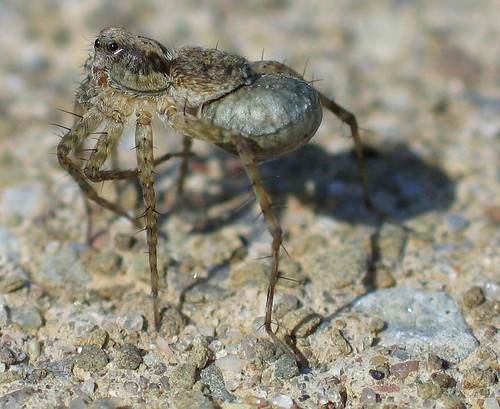
Female Wolf Spider with egg sac
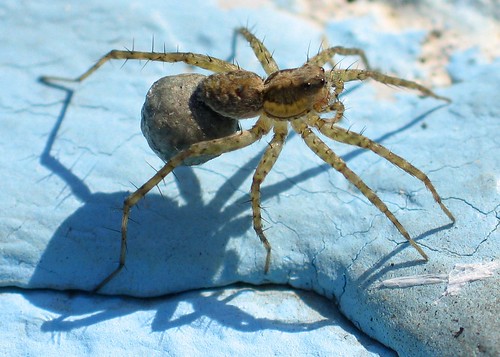
Latin name: family Lycosidae
Here's the same Wolf Spider mother at the edge of the pool. Note how she is not carrying herself so high due to the cooler temperature at poolside.
Female Wolf Spider with egg sac
Latin name: family Lycosidae
I was at a public wading pool with the kids this past Saturday. It was rather hot, over 30 degrees. The kids had a great time splashing around. While the kids were lying on their towels soaking up the heat, this little female Wolf Spider with her egg sac tucked beneath her abdomen ran out from the grass onto the cement that surrounds the pool by about 3 metres. It initially ran under Janneke's towel. I shooed the spider away so that it wouldn't bite Janneke if she inadvertently rolled onto it. The spider ran back into the grass and disappeared from sight for a while. About five minutes later she (the spider) reappeared and made a beeline for the pool, in a quick run interspersed with little jumping hops. She went to the edge of the water, took a drink, then proceeded back to the grass. I got a few shots of her as she paused periodically. Note how she raises herself up as far as possible from the hot cement.
Capitalization
I have been at a loss as to the rules of capitalization for named insects. Wikipedia has a good entry on capitalization. Here is a relevant snippet:
Some authors, though few if any grammar books, also treat the names of individual species of living things (animals, plants, etc) as proper nouns, and use initial majuscules for them, as in e.g. Peregrine Falcon while asserting that others, e.g. horse or person are not common names of species and should not be capitalized.
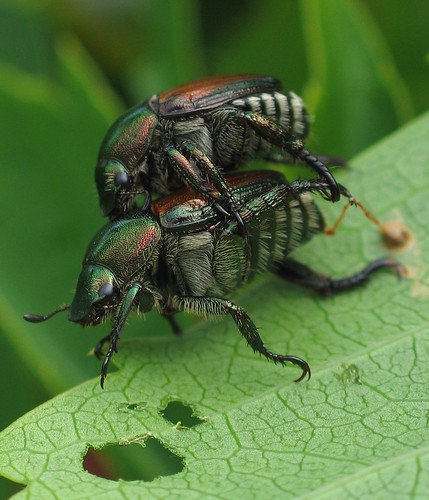
Mating Japanese Beetles
Latin name: Popillia japonica
We visited friends in Welland this past Sunday. They had a rather wild area behind the garage full of Goldenrod, Mint, and grapes that grew over the fence. These Japanese Beetles were found on grape leaves and were obviously in some state of mating. You can see some sort of discharge from the female (the one on the bottom). I am happy with the lighting intensity and clarity of this photo. The field of view is pretty close to lateral, giving good focus along the length of the beetles with a bit of a bias to their heads. This picture has been having a good run on the top20macro group on Flickr (a sort of Darwinian-modelled group whereby everyone is an administrator, only one post per day is allowed, and only 20 posts are allowed in the group).
I had noticed that some Japanese Beetles took on a pose whereby their hindmost limbs would splay out to the side. I think this may be done by females in order to provide purchase to the male when mating (you can see this in the photo). I don't think Japanese Beetles play coy when it comes to reproductive rituals. They pretty well just go at it. Often one can find two beetles mating with a third (presumably a patient male) sitting nearby.
Subscribe to:
Posts (Atom)