
I love photos of invertebrates doing things. Several of these burrowing wasps were busily, ah, burrowing in the sandy gravel along a roughed-out road. They would quickly dig the burrow, then spend quite a bit more time getting it just right. These wasps will paralyze an insect and bring it back to the burrow, laying their egg or eggs on it so that when hatching occurs, the new larva or larvae have something to sustain them.
Friday, July 20, 2007
Monday, May 28, 2007
What captivates

This Flesh Fly has a lot going for it, photogenically. It's got big red eyes that draw human attention. It's body is grey, allowing the red eyes to stand out even more. This shot has the fly's head cocked a bit and one leg lifted off the leaf. If one wants to identify an insect one wishes a clear view of all major body parts. Aesthetics come with a different set of values. Aesthetically, it's ok to have a sharp foeground and fuzzy background, in fact, it looks better that way. I always feel so sad for the poor pinned bugs curled up and dessicated on their pins.

Small Serengeti

I love this shot. Wish I'd had the flash up a bit more to get at detail for the ants close into the wood louse, but there's plenty there to tell a good story, nonetheless. The wonderful level of activity and interaction one can find just by looking down as one treads a path is awe inspiring. These Acrobat Ants were gathered around a wood louse, slowly picking it apart until I imagine they'd cooperatively carry it away. The one on top with her back arched is displaying in response to a threatened approach by an ant from another species. Besides lighting, focus was the most challenging aspect of this shot, as limited depth of field forced me to choose carefully what parts of the frame to highlight. I opted for the carapace of the wood louse and as many of the gathered ants as possible.
Wednesday, May 23, 2007
All that I got

There's a neat bee fly in our garden. He's brown and fuzzy. He tends to stay in one place for about ten seconds, then fly to a new spot or return pretty much to the same spot after flying around for a while. This bee fly is shy, so I've been trying to take a photo of him at much less than 1:1. This is the clearest I got, a photo captured just as he/she was taking off. I'm sad I didn't get more but happy I happened to get a clear shot of the takeoff.
Since I've moved from my obsession with photographing ants I've been having a bit of difficulty photographing things that aren't 5mm long. Ants, besides being small, are pretty horizontal, meaning that a lot can be captured with minimal depth of field. Bees on flowers or larger flies, wasps, and bees in general, are difficult to capture doing something ineresting at 1:1 magnification. Either depth of field limitations ruin important detail or interesting context just doesn't fit. I'm having to experiment with less than 1:1 magnification, flash levels, and aperture to keep getting good bokeh.
Friday, May 18, 2007
Frustration and reward

How can I take credit for interesting shots of tiny creatures? All I have to do is walk out my front door, sit down on an overturned bucket, and take a few dozen pictures. A few always turn out well. Ants have caught my attention in a big way for the past few days. I've discovered that there are at least five species in our front yard and driveway alone, something I never would have guessed had I not begun to photograph them. False Honey Ants and Acrobat Ants are the two species that graze on the sweet setae (hairs) that grow from the buds, leaves, and stems of the Bachelor's Button plants in our front garden. The individuals in this photo are False Honey Ants, engaging in a brief moment of contact to ensure they are indeed from the same colony. I have a Nikon D50 camera with a Micro Nikkor 60mm lens. This gives me 1:1 capability. Yesterday, I added in a clip-on Raynox M250 closeup lens, which finally gave me eye detail. The combination of equipment and settings is reasonably simple and leads to good results if one keeps at it. The other factor is an interest in finding good subjects and taking the time to get to know them and take lots and lots of photos of them. This shot was taken with onboard flash diffused through the plastic of a vinegar bottle after 5:00 PM. To compensate for the reduced light I bumped the ISO to 400. I've found that increasing ISO helps with exposure but does lead to slightly increased graininess particularly noticeable on out-of-focus areas.
False Honey Ant clearing food from its jaws

Cant' stop photographing these little wonders. Good for both my photographic technique and my soul. Apparently, False Honey Ants eschew weather that's too warm, preferring to come out when it's cooler and lay low when it gets too hot. They have taken over the Bachelor's Buttons in our yard. I still see some Acrobat Ants browsing on the flowers, but seemingly fewer and fewer. False Honey Ants are slightly larger than Acrobat Ants and thus a bit easier to capture photographically. They are also more apt to move about, making it tricky to get shots of them, but more likely that they will be interesting shots like this one. Acrobat Ants tend to spend their time with their heads down, not just down low, but pointing downward to the ground. Much more difficult for a giant like me to photograph.
Wednesday, May 16, 2007
Regurgitating

I need to learn more about what this ant is up to. It seems to be regurgitating its food. At first when I saw False Honey Ants I doing things with their forelimbs I thought that they were preeing. It turns out they were at least some of the time playing with their food.
Artsy

I like this shot. Ants don't tend to spend a lot of time near the flower part of the Bachelor's Button plant, so getting a shot of them there takes a bit of patience and a lot of tries. I had the camera angled for this shot, resulting in this sideways view that I decided not to correct. Things I like best about this shot include the purple of the emerging flower petals, the gentle folding of the petals, the black background of most of the shot, and the brown translucence of the False Honey Ant.
Lasius alienus

This is the ant very common in Ontario which one sees building and maintaining small ant hills in sandy soil. Found out this ant is a member of Lasius alienus. All-in-all I've found five species of ant in our front yard and dirt driveway so far this spring. Amazing what you find if you look.
Formica sp. - pallidefulva group

This ant is found foraging all over our front yard garden and driveway, bringing home dead insects, or getting a meal of nectar, as in this photo. I've submitted it for identification to bugguide.net. When it comes upon Acrobat Ants on a Bachelor's Button plant it is chased away. After this it tends ot run around the plant a bit then go back to where it encountered the Acrobat Ants, only to be chased away again.
False Honey Ants - Prenolepis imparis

Here are some False Honey Ants gathering nectar from extrafloral nectaries on a Bachelor's Button plant. Extrafloral nectaries are growths that are rich in sucrose and tend to attract s of ants. It is presumed that extrafloral nectaries serve to protect the plant from unwanted pests, as the ants will chase off other insects. Note that False Honey Ants have large abdomens, an indication that they tend to ingest food that will later be shared with the colony.
Pavement Ant - Tetramorium caespitum

Here's a Pavement Ant, not terribly poetically named. Its abdomen is much smaller than that of the Acrobat Ant, probably because it brings home scavenged food rather than ingested nectar. This one was "scavenging" another Pavement Ant that wasn't dead yet and vigorously resisted being carried along.
Acrobat Ant - Crematogaster sp.

I found out that this is an Acrobat Ant. I imagine its propensity for stooping down to eat made those who named it think of an acrobat. It has a rather large abdomen, presumably for holding food, and a spiny protrusion dorsolaterally on each side of its thorax.
Monday, May 07, 2007
Insect behaviour and tricky shots

It's tricky to get a good shot of an insect in mid-flight or any sort of closeup shot, for that matter. Getting a good shot often involves a bit of understanding of insect behaviour. Here are a few categories I've found.
- Insects that are really tired or are trying to warm up in the sun tend to let you get closer. This is especially true of spring insects like bee flies whose ability to function in cool spring air is only marginally possible. The fact that they're out at all is driven by a reproductive or foraging need. In the case of bee flies, they need to lay their eggs near those of solitary wasps so that their larvae can locate the wasp larvae and eat them.
- Insects that are busy mating often ignore pretty much everything going on around them in order to mate (thus, the proliferation of mating bug shots).
- Insects eating are less likely to be shy than those foraging (thus the dining spider and bee and butterly shots you see).
- Insects that think no one sees them and depend on immobility for safety tend to stay put (I just posted a picture of a well-camouflaged crab spider on a fruit tree displaying this behaviour).
Visual capture and colour

Flowers and colour are great attractants for people. I may love a shot of an ant carrying a dead worm or a spider, but not many others seem to. Post a picture of an Eastern Carpenter Bee resting on a tulip petal, though, and you've got peoples' attention. It's jaws close from the sides and seem to be well suited to the need to bite into wood, severing vertically running fibres.
Tuesday, May 01, 2007
Small things and the limits of cameral equipment
Here's a photos of a small ant I took today. It turned out quite well, much better than with my previous non-SLR camera, but it points to a few things I'll be working on with my macro photography.
One of these macro issues I've just found out about is diffaction effects at small aperture settings. Here's a great article on the subject. Wikipedia has a nice article on part of the theory behind the issue. Essentially, the smaller the aperture allowing light to pass from the lens to the sensor or film, the more likely individual waves of light are to overlap with each other, creating fuzziness in the image. Other variables involved include the size of the sensor, the size of the individual sensor receptors, and the focal distance. Of course, the quality of the lens passing light to the sensor is an important factor as well. People say that one should be able to take good photos no matter what equipment one is using. This is true to a certain extent, of course. I am very happy with many photos taken with my previous non-SLR camera. However, smaller sensor size, smaller aperture, less sharp optics, and the inability to use flash made getting a sharp picture more difficult. The page I linked to above has a nice calculator that lets you figure out how small you can set your camera's aperture before diffaction effects manifest themselves. My camera at macro focal distance apparently can be set up to f14 or f16.
Availability of light is another issue with any photography. For my macro photographs when not in bright sunlight I've started to use my on-camera flash with a homemade diffuser at the end of the lens cut from a vinegar bottle. Unfortunately, with flash, the camera seems to want to set shutter speed to 1/60 second. At this speed motion blur can be an issue. I will try experimenting with setting ISO level to 400 or 800, seeing what using a wider aperture does, and when I am confident enough, setting shutter speed manually as well.
Another always-present issue with macro photography is the very shallow depth of focus one must deal with, also known as depth-of-field. Another nice page on the diffraction effects site (cambridgecolour.com) deals with depth-of-field. A nice calculator is included on this page as well that allows depth-of-field for varying focal lengths, subject distances, apertures, and camera sensor sizes to be estimated. At f16 I should get about a 5mm depth-of-field. At f14 I should get about 4.5mm. This means that taking a photo head-on of a 7mm ant at most 4 to 5 mm of the subject will be in sharp focus. Focusing at such close distances is tricky, so one often gets a situation where sharp focus begins a bit in front of the subject, so one might only get 2 or 3 mm of sharp focus. This explains why one sees lots of side-shots or top-shots of macro subjects. The area of interest all falls within the depth-of-field focal range for these shots.
Sunday, April 29, 2007

Using Flash


Ok, I admit now that flash is useful in macro work. I had been one to poo-poo the use of flash. Perhaps this was doe to having seen too many over-lit photos. The other day out of curiousity I decided to find out what I could get out of the built-in flash for my Nikon D50. By itself, with lens extended all the way I got a shadowed section on about 20% of the photo where the flash could not reach. So, I rigged up a diffuser using a cutout from a vinegar bottle. It diffuses, of course, and also sends the light down where the onboard flash would otherwise be blocked. I've found that it works well to warm up my photos without being harsh. It also to allows me to freeze action and thus get better detail on my macro shots.
There are two funnel spiders in our basement, a male and a female. The male hangs out at the entryway to the funnel and the female hides inside. Nancy saw the male this afternoon and wanted to kill it. Janneke loved it, as did I. Without flash it would have been impossible to photograph in our basement. However, with the flash and diffuser, I took some pictures. At this point Janneke decided she wanted to feed the spider. She found a wood louse and we put it by the lair. That's when we saw the female for the first time, emerging from the funnel web. The male kept his distance and absolutely ignored the food. He obviously only wanted to mate. The female grabbed the louse and quickly retreated with it to the funnel. She also did this with some Milkweed Bugs we gave her too.
Wednesday, April 25, 2007
Descending

Here's an ant going down the other side of an obstacle. Amazing ability to traverse terrain. Looking at this one, you can see that ants are well designed for strength. It's body is rigid and its legs provide great leverage. Just amazing.
Alone

One of my best insect photos. This ant was pausing at the crest of a plant branch before beginning her descent. Standing at the crest of a hill and looking over the horizon is something that people can identify with. The sky was overcast when shooting this photo, so glare is reduced, both on the ant and the succulent plant that in sunlight produces lots of points of glare.
Investigating

I like this shot. To get it I lay flat on the ground and had the lens pretty much parallel to the ground. The ant's head is in focus and her antennae are outstretched, indicating, I think, investigation. It's amazing what can be done with six legs, pheromones, and a finely honed neural network. It's also amazing how much one comes to love and respect small creatures that one would tread on for fun as a child. My father stopped me from doing this one day when I was about seven I think. He told me that the ants in the hill I was obliterating were living things and deserved respect. This has stayed with me.
Investigating

Here's one of my recent ant pictures, taken with the new Nikon D50, and just as importantly, a 60mm Micro Nikkor AF lens. I'm sure I will take many more photos, some of which will be better, but I like the action in this one. These ants were congregating around a wilted flower and dead midge. The midge was eventually carried away. All of my ant shots so far, except those taken on a cloudy day, have driven home how useful a polarizing filter would be in reducing glare. So, I ordered one today, a B+W 62mm polarizer. It's a good one, made in Germany. Within limits, my philosophy is to purchase good quality things, spending a bit more to get something that will be more useful in the long run. I applied this philosophy to my polarizer puchase, paying $50 instead of $25 for a multicoated polarizer with brass ring mount rather than an uncoated one with an aluminum mount.
Monday, January 08, 2007
The Mac
I have an IMac now. It's a 20" one with a 250 gig hard drive, 2 gigs of ram, and a nice dual core 64 bit processor. From a hardware point of view I'm very pleased with it. From most points of view I'm pleased with it. Here a a few things that I notice, coming from Linux:
Lack of a unified package management system - Managing core aplications is a breeze. They're represented by litle icons but are really directory structures containing all needed files and resources. Just drag to wherever you want them to run from or run them from where they are by double clicking on them. Managing non-core things like Perl libraries is not so neat and tidy. Perl comes with the system, but CPAN itself does not in and of itself manage uninstalling. The berkley ports system, called macports, not surprisingly, is available. It is very good, but duplicates things like perl. So you are left needing to keep track of what is managed by what. Core compiler and other development stuff is updated by Apple. Java is updated by Apple. Apache 1.3 comes with the system and is integrated nicely into the preferences panel. If you want Apache 2 you can use macports to install, uninstall, update, etc. it. The same pretty much goes for anything else. I find myself being a bit on my toes all the time as I wonder whether or not I'm using the right system. This is about how I feel on Linux installing something from source that is spread all around the place.
Apple's desire to push products - Apple has a nice (I suppose) email, contact, and storage service called .Mac. Want to share contacts between users on the same computer? Use .Mac, family edition (really an ldap service). The same goes for things like common storage for things like photos or video. Each user's resources are kept on their own. Sharing, with all of the permissions issues that go along with that, is a more complicated and freelance activity not spelled out at all by Apple because they would allow you to avoid .Mac or some other server product. I am technically sophisticated enough to figure out how to set permissions up so that such file sharing will work, but this sort of thing should be built in. As far as I can tell, openldap can be installed easily enough using macports, but there is precious little help from Apple in getting the needed schemas set up so that it can work properly as a .Mac address book replacement.
Too many modifier keys - The bloody apple key is cute and all but ends up adding another modifier to keep in mind when trying to figure out how to do something like select a word or a paragraph when coding or composing a document. Makes me thing of the gymnastic requirements of emacs usage. I'm sorry, but although I am sure there are indeed useful things one can use the apple key for, mostly I find it adds a complexity multiplier. Apple is famous and appreciative for a less-is-better approach in its design. The apple key works against this. Perhaps I'm not "apple" enough yet. It was probably more useful to allow pseudo right-clicking back when Apple only had one button mice (because they were more simple, I suppose, but holding down a key when clicking to simulate a right-click seems to me to be cheating).
Beyond these gripes I am impressed with the excellent indexing and searching capabilities built right into most applications, the usefulness of a truly shared address book, the general way that things just work without trying to tell you all the details like a proud dog, the way applications icons bounce helpfully to tell you, for instance, that an IRC or IM message awaits, that a file is downloaded, and the prettyness of it all. The wide screen real estate is a huge luxury. Using the built in remote to trigger the theatre application is fun and useful. Fast user switching means that my wife and daughter get to share the computer easily. The office suite is good and was much cheaper than office. The list of happy points is long. Most of my gripes are those of someone being able to manage things well in a debian-based linux system. If Apple embraced an integrated the macports system I'd be impressed and happy.
Thursday, November 16, 2006
Sitemaps protocol no longer just for Google
As Brent might say. Google's sitemaps protocol, mostly just an XML schema to lay out the important bits of your site for web crawlers, is being set up as a more neutral protocol to be used by Google, Yahoo, and Microsoft. I suppose this is just recognizing the fact that though initiated by Google, the sitemap files can be read by anyone. Collaboration in this is pretty easy and makes for good PR. I am planning a site that will be most fun if it uses lots of dynamically fetched and generated content. Unfortunately, this will make it inscrutable by HTML-parsing search engines. Laying out a site map that points to raw content with as much metadata as possible will make it much easier to reliably ensure that search engines get the most information possible. The key is to allow Google or another advertiser maximum exposure to site data and meta information so that ads can be properly targeted. The issue that remains for me is whether or not Google will frown on sending ads to a black box, i.e. will they trust that my AJAX site when calling in Google ads with given keywords is serving up the same contents as is indexed through my sitemaps file. The irony of a lack of trust in my situation would be that I am planning on using Googles Web Toolkit (GWT) to build my dynamic site.
Here's what Netcraft says about the site:
http://www.sitemaps.org was running GWS on unknown when last queried at 16-Nov-2006 08:56:49 GMT
Here's what Netcraft says about the site:
http://www.sitemaps.org was running GWS on unknown when last queried at 16-Nov-2006 08:56:49 GMT
Wednesday, November 15, 2006
AJAX and web crawlers/advertising
I've been looking into the topic of how to both have an AJAX/DHTML website using a toolkit like prototype or an interface infrastructure like Google Web Toolkit. It boils down to the fact that if you need to let the web crawlers in you have to give them something non-DHTML/AJAX to consume. This can be done a few ways it seems, including intercepting page requests and directing to different handlers based on who's requesting and having a parallel site, one AJAX and the other plain old HTML. Another option is to limit the AJAX to page elements that make things more convenient and functional for the user; things like hide/show login areas, etc. Again, the point is to have a strategy to let the web crawlers in.
I'm thinking about all of this in the context of setting up a site that needs to be indexed properly by Google in order for Adsense to work properly. I'm leaning toward the route of having an entry point for web crawlers and another one for the application with exactly the same core content visible on both. The web crawler content would be optimized to provide maximum meta data and minimum extraneous bulk. I'm leaning to this solution because I am intruiged by the Google Web Toolkit and its ability to be used to build a content-rich site. Of course, I'd have to get a half-decent development machine to do this as well since the GWT uses a model whereby the application moves from a Java one in development to a JavaScript on at deploy time. The Java/Eclipse/etc. part is pretty resource intensive methinks.
I'm thinking about all of this in the context of setting up a site that needs to be indexed properly by Google in order for Adsense to work properly. I'm leaning toward the route of having an entry point for web crawlers and another one for the application with exactly the same core content visible on both. The web crawler content would be optimized to provide maximum meta data and minimum extraneous bulk. I'm leaning to this solution because I am intruiged by the Google Web Toolkit and its ability to be used to build a content-rich site. Of course, I'd have to get a half-decent development machine to do this as well since the GWT uses a model whereby the application moves from a Java one in development to a JavaScript on at deploy time. The Java/Eclipse/etc. part is pretty resource intensive methinks.
Monday, November 13, 2006
Two bug firsts
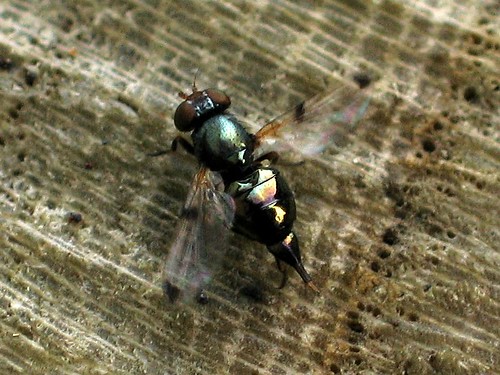
Two of my bugs have made their way on bugguide.net as firsts in their category. One is a picture wing fly. I found it on the stump of a recently cut-down tree in our drive.
The other is a sap feeding beetle. This one was on a moon flower in our neighbour's small but wild front yard.
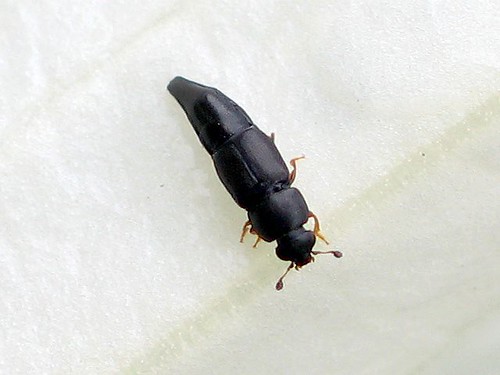
The other is a sap feeding beetle. This one was on a moon flower in our neighbour's small but wild front yard.
Wednesday, November 01, 2006
Ladybug takes flight
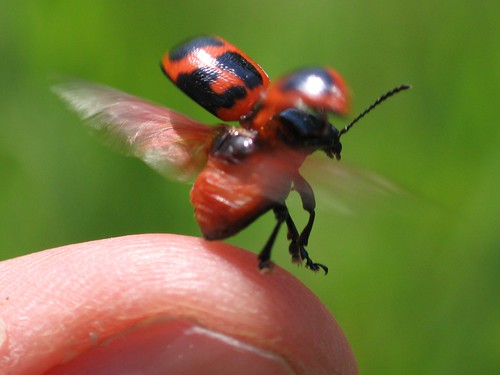
I've not taken photos of bugs since May, but while camping at Selkirk Provincial Park I got this fluke shot of a ladybug taking flight from my thumb.
Wednesday, September 20, 2006
A Java vs. Ruby example
Here’s some Java code I borrowed and wrote to extract multi-word tags surrounded by quotes from a string and add them to a list
Here’s the Ruby equivalent// Now extract all multi-word keywords delimited by spaces
// but not surrounded by quotes
p = Pattern.compile("\"(.*?)\"\\s*");
m = p.matcher(keywordString);
sb = new StringBuffer();
while (m.find()) {
// Get previous match and add it to the keywords list
String kw = m.group();
if (! "".equals(kw)) {
kw = kw.trim().replaceAll("\"", "");
keywords.add(kw);
}
// remove the current match from the string
// and thus from consideration
m.appendReplacement(sb, "");
}
m.appendTail(sb);
keywordString = sb.toString();
keywordString.gsub!(/\\"(.*?)\"\s*\/) {keywords << $1.strip}Saturday, August 26, 2006
OpenID
I've been investigating (and testing) OpenID lately. The cause, by the way, would be helped if openid.org's url worked without the www subdomain. Openid is an api that allows a person to claim ownership of a url and through that to claim an identity of sorts. It's not a way to prove that a person controlling a url has a certain name, so it's not an authentication mechanism. What it allows is for identity verification to happen in one place rather than over and over and over again in multiple places. An OpenID url I've gotten is ian.marsman.myopenid.com. With this I can log in to livejournal.com, zoomr.com, and other OpenID-using sites. The benefits for the user include the need to have a single identity verification location that can be used on multiple sites. A web application developer using openid as a login mechanism doesn't need to worry about account registration, which is rather nice.
The business model for providing and managing OpenID accounts does not seem to be that promising if that's all one is providing. The API is public and client and server libraries are available in a number of programming languages. One would need to use account management as a way to gain credibility for an identity management consulting business or add extra services on top of the base account management. claimid.com is doing this (or will be once they're out of beta). They seem to want to offer a way for people to point to various urls about the 'net and say "this is mine or about me". They also offer the ability to register other OpenID urls with their site which can be verified by them (the OpenID api allows for this).
In any case, I've installed and gotten running the Ruby version of OpenID. It's available as a gem, which I can't install easily on my non-root-access account. I've thus put all openid libraries under the lib directory of my rails application. This works pretty well. The sample openid_login generator is found and thus can be installed if one puts it in one's ~/.rails/ directory. openid_login.
One gold rush identity management system I'm not crazy about is i-name. i-names can look like "=ian.marsnan" for a personal i-name or "=@myorg*ian.marsman" for a person at an organization. I'm not crazy about this setup because the going rate to register an iname is twenty bucks US. For this, one gets more control over who you give what personal info to. However, OpenID has the ability to create profiles and choose which profile to give to a site that's requesting permission to access one's identity. i-name is an api designed by rather large organizations. OpenID is more grass roots, although Verisign is on the standards committee. Who knows how things will pan out. Both offer the hope of single sign-on. i-name seems more targetted at uses for businesses like corporate identity management and online banking signon authentication. It's a big topic and I'm starting to wander. At the moment all I want is a way to offload user signup management and give people a way to avoid adding my site as another to keep membership track of.
Wednesday, May 31, 2006
DIGITAL MAOISM: The Hazards of the New Online Collectivism
A great piece on the risks involved in building knowledge using groups. Essentially, the author seems to be suggesting that the results of consensus is not necessarily genius or deep insight, but rather blandness or at the very least, something lacking in boldness and insight. A great read.
The beauty of the Internet is that it connects people. The value is in the other people. If we start to believe the Internet itself is an entity that has something to say, we're devaluing those people and making ourselves into idiots.The trick is to allow people to have a say and interact while preserving the individual. The article's not a slam against algorithms or Wikipedia, but rather a call to carefully consider how peoples' individual and collective wisdoms can best be used without wiping each other out.
Subscribe to:
Posts (Atom)